
Chemung County Deed Records and What They Show
Chemung County runs its property records on separate official systems. Recorded instruments, assessment data, parcel geography, and tax accounts each sit in their own database. The annual roll identifies the municipality, tax-map number, and property location. It also lists owner and mailing fields, assessment, exemptions, taxable values, and the deed reference. SearchIQS supplies the grantor-grantee index and recording details. The ArcGIS service provides map context, while the Treasurer system carries dated account information. These systems refresh on different schedules. Save each result with its source, year, retrieval date, and limits.
| Deed Type | What It Does | Common Use |
|---|---|---|
| Warranty deed | Full ownership with guarantees | Standard sales |
| Quitclaim deed | Transfers whatever interest exists | Family, divorce, cleanup |
| Grant / special warranty | Limited guarantees | Some sales, New York custom |
| Trustee / executor deed | Transfer from an estate or trust | Probate, foreclosure |
| Tax deed | Transfer after a tax sale | Delinquent-tax properties |
No single database holds everything in Chemung County. Recorded instruments, assessments, parcel geography, and tax accounts are kept apart by design. The annual roll lists the municipality, tax-map number, and property location. It also lists owner and mailing fields, assessment, exemptions, taxable values, and a deed reference. Grantor-grantee indexing and recording details come from SearchIQS. Map context comes from the ArcGIS service, and the Treasurer system adds dated account information. Save every result with its source, year, retrieval date, and limits. Each system refreshes on its own schedule.
The Chemung County Grantor-Grantee Index
The grantor-grantee index is only one piece of Chemung County recordkeeping. Recorded instruments, assessment data, parcel geography, and tax accounts sit in separate official systems. The annual roll gives the municipality, tax-map number, property location, owner and mailing fields, assessment, exemptions, and taxable values. The same roll lists the deed reference. SearchIQS then supplies the grantor-grantee index and recording details. ArcGIS adds map context. The Treasurer system supplies dated account information. Each system refreshes on its own schedule. Record the source, year, retrieval date, and limits whenever you save a result.
- Preserve the exact address, municipality, tax-map number, source date, and record reference before moving to the next official system.
- Preserve the exact address, municipality, tax-map number, source date, and record reference before moving to the next official system.
- Preserve the exact address, municipality, tax-map number, source date, and record reference before moving to the next official system.
- Preserve the exact address, municipality, tax-map number, source date, and record reference before moving to the next official system.
- Grantor
- The party transferring - the seller.
- Grantee
- The party receiving - the buyer.
- Chain of title
- The ordered sequence of deeds for a property.
- Book/Page vs Instrument #
- How Chemung County references a recorded document.
Getting a Copy of a Chemung County Deed
Getting a deed copy in Chemung County means drawing on several systems. Recorded instruments, assessment data, parcel geography, and tax accounts are each kept separately. The annual roll identifies the municipality, tax-map number, property location, owner and mailing fields, assessment, exemptions, taxable values, and the deed reference. SearchIQS provides the grantor-grantee index. It also supplies recording details. The ArcGIS service supplies map context, while the Treasurer system supplies dated account information. Save each result with its source, year, retrieval date, and limits. These systems refresh on different schedules.
Recorded, not guaranteed. 1-2 sentences - the Chemung County deed index shows what was recorded; it is not a title opinion, and unrecorded interests can exist. A title search confirms clear ownership.
Older Chemung County Deed Books
A deed chain that hits July 31, 1967 has reached an online boundary. That date is not the start of the property. Older material still exists. The Chemung County Clerk's historical indexes reach further back. The FamilySearch Chemung catalog lists deed books from 1825 through 1910 and indexes through 1968. Steele Memorial Library directories and atlases can resolve a changed street or spelling. But every historical clue must return to a deed book, page, grantor, grantee, and legal description. Only then does it earn a place in the chain.
Label each finding for what it is. An index entry is not the same as a document image or a certified copy. A directory entry or a map inference differs again. If no image exists online, ask the Clerk for the volume and page. Do not describe language no one has seen. That discipline keeps older Chemung County deed records useful. It also stops an index entry from proving more than it can.
The Chemung SearchIQS subscription page shows the account and image choices for deed records.
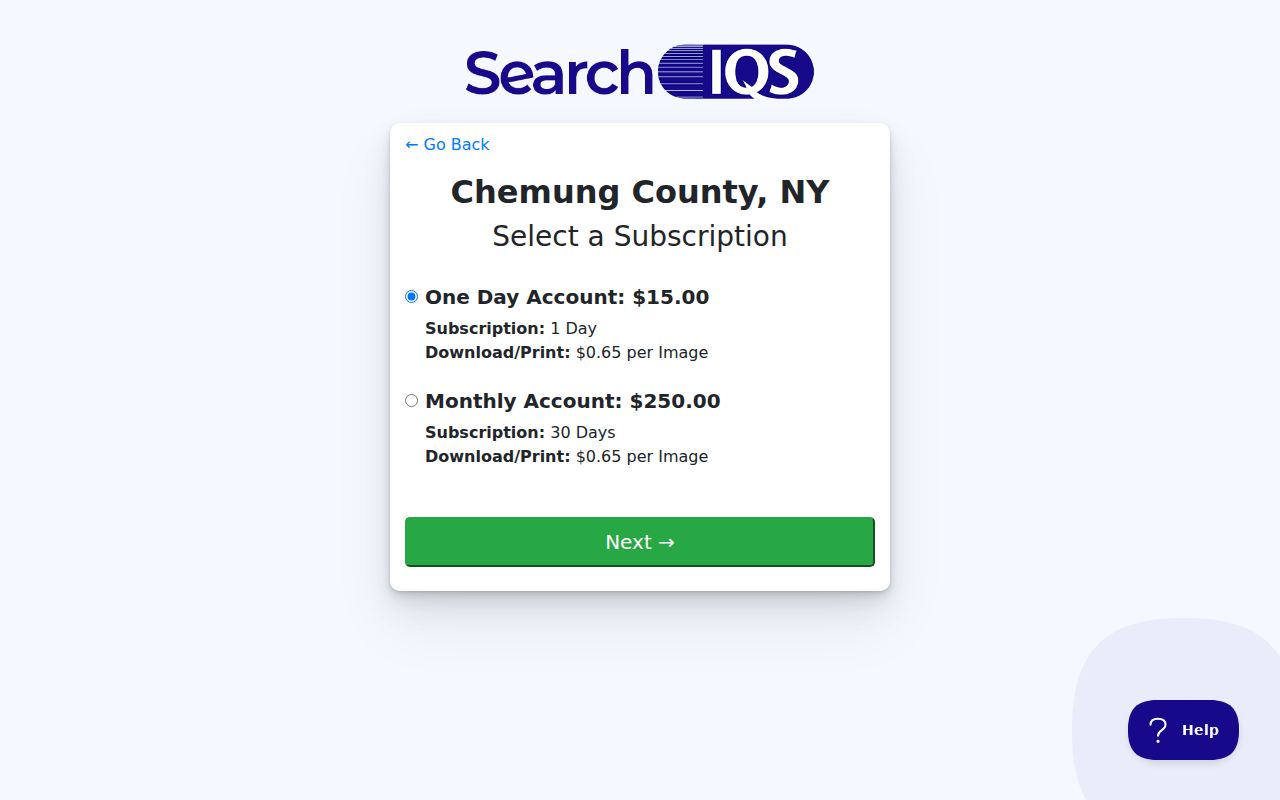
An index entry can appear for free while the underlying image sits behind paid access. The historical index-books help page shows the older-volume workflow.
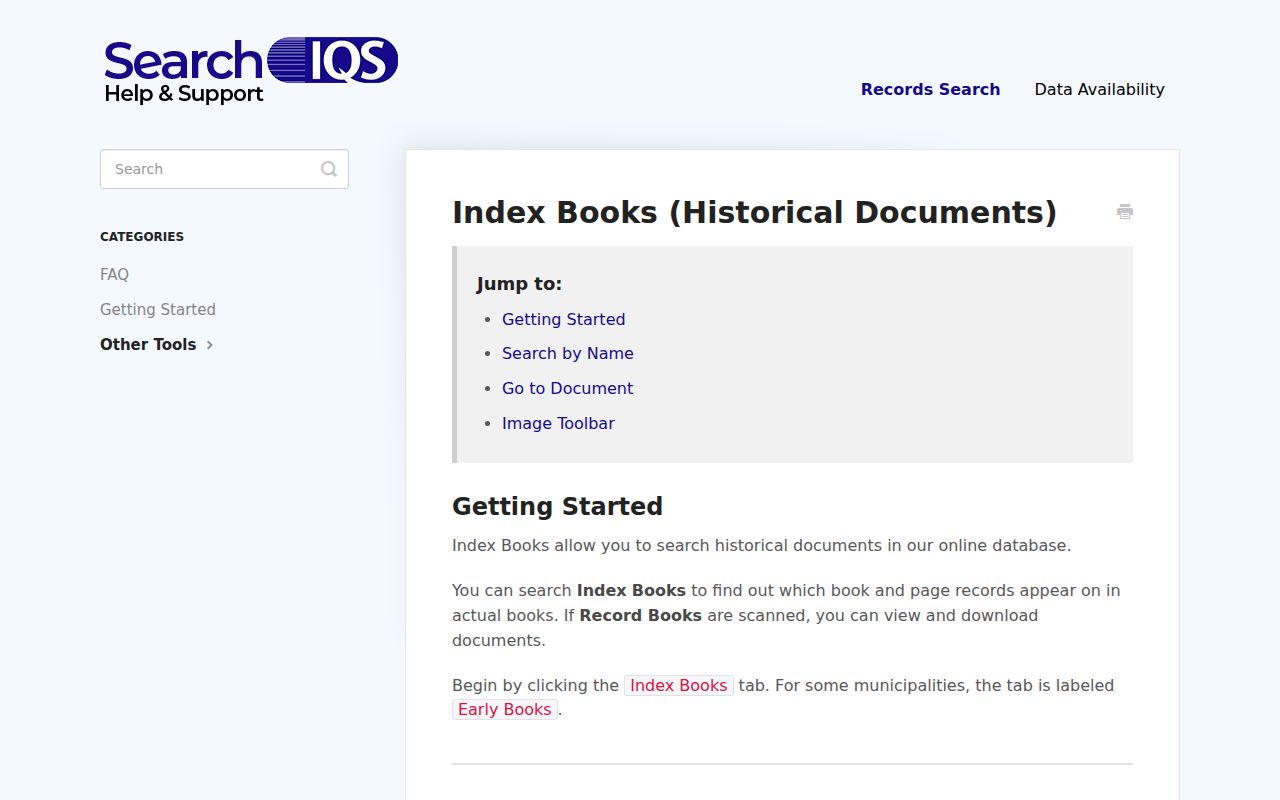
The historical screen bridges chains predating modern deed coverage.
SearchIQS Fields for Chemung Deeds
Chemung County deed records are searched through party and document fields, not one parcel card. SearchIQS supports Party 1 and Party 2, party type, a recording-date range, document group and description, town, book and page, and instrument or case number. Partial names and wildcards can surface spelling variants. Narrow broad results with the parcel municipality and the deed date. A postal address using "Elmira" may belong to the City of Elmira, the Town of Elmira, or another nearby taxing area, so pull the town filter from the assessment roll or the county parcel layer rather than the mailing address.
Start from the exact owner caption printed on the roll. Keep the initials, punctuation, trust language, "estate of," or entity suffix intact. Search that party as a grantee to locate an acquisition. Search again as a grantor to locate a later transfer. When the roll prints a deed book and page, test that reference before any name-only query. Preserve the document description, parties, recording date, instrument number, book and page, town, and image marker from each result. Those fields make the search repeatable. They also reduce the risk of attaching a namesake's deed to the wrong Chemung County parcel.
| Search field | Best use | Check before relying |
|---|---|---|
| Party 1 / Party 2 | Grantor and grantee names | Role can vary with document type |
| Town | Narrow the legal municipality | Do not rely on postal city alone |
| Book / Page | Follow a roll or prior-deed reference | Preserve leading zeros and format |
| Instrument number | Retrieve a known filing | Compare parties and description |
Chemung Deed Coverage by Series
Chemung County groups its recorded instruments by series. Each series starts at a different date. Deeds reach back to July 31, 1967. Mortgages begin in February 1970. Judgments start in 1992, and both lis pendens and delinquent-tax records in 1998. Consolidated liens begin in July 2000. Federal tax liens, by contrast, cover all years. A searcher who comes up empty should say exactly which series and date range was checked. A blank screen proves little. Older paper records, a name indexed differently, or a restricted filing can all sit outside the online index.
Related filings take separate searches. A mortgage in the Chemung County property records does not reveal whether a satisfaction was recorded later. A lis pendens is only notice of a pending action, never a ruling on ownership. A tax-lien entry is not a payoff figure. Note the original filing first, then chase later releases, satisfactions, assignments, judgments, and deeds by the same parties and reference numbers. When legal priority or enforceability is at stake, pull the documents and rely on a title professional or attorney rather than an index list.
Images, Indexes, and Certified Copies
SearchIQS guest access can show index details without opening the full recorded image. The county-linked subscription page lists a one-day account at $15 and a monthly account at $250. Images run $0.65 each. Those fees and terms can change. The live subscription page controls the current price. Treat any hit without an image as an index lead. Never claim that an unseen deed holds a certain legal description. The same goes for a consideration clause, reservation, easement, or signature.
The Chemung County Clerk remains the official fallback for deed records. The office sits at 210 Lake Street in Elmira. Mail goes to PO Box 588, Elmira, NY 14902, and the phone is 607-737-2920. Hours run Monday through Friday, 8:30 a.m. to 4:30 p.m. Recording acceptance ends at 4 p.m. Ask about the current copy and certification charge, the book or instrument you need, and whether an appointment or account is required. A legal filing, court matter, or title transaction may call for a certified copy rather than a downloaded page.
Reading a Chemung Deed Image
Open every page and exhibit when a deed image loads. Record the execution date and the recording date separately. Note the deed type, each grantor and grange, the acknowledgment, any consideration or transfer-tax field, the prior deed reference, tax-map number, legal description, return address, and page count. A street address is just a handy locator. Lot and block language, a subdivision plat, metes and bounds, and the prior instrument reference anchor the parcel far better when an address changed or the land was split.
Not every deed records an ordinary sale. Quitclaim, correction, executor, trustee, sheriff, governmental, and tax-foreclosure deeds each do different work. Keep the document type instead of labeling every transfer a purchase. Copy co-owner and vesting language exactly. Never infer a personal relationship from it. Finally, compare the deed's parcel description against the Chemung assessment roll and GIS map. The roll gives an administrative owner snapshot and a deed reference, while the GIS map adds context. Neither one replaces the recorded instrument. The GIS polygon is not a survey.
Recorded is not guaranteed title. Chemung County deed records document filed instruments, but the index does not decide validity, priority, boundary rights, or clear title.